
The pore-bearers!
Sponges or Porifera (from the Greek “póros” = pore + “féro” = bear, hence meaning ‘pore bearer’) constitute a fairly well-defined group of animals, present in all aquatic environments in the world (seas, oceans, rivers and lakes), from the intertidal zone to the great depths and from the equator to the poles. Sponges are sessile, erect, massive, but mainly encrusting animals, forming thin layers on hard, natural and artificial substrates; however, in favourable environments such as coral reefs or deep-sea environments, can reach considerable sizes and they can constitute a significant portion of the habitat’s biomass.
The poriferans have an original organizational system that allows them to filter the surrounding water. The water entry holes in the sponges, the ostioles or inhalants pores, are distributed over the body surface. From the pores, the water runs through the body of the sponge through two networks of channels: the inhalant, that carry the water from the outside to the choanocyte chambers and the exhalant, which collects water from all the chambers and expels it outside again. The set of pores and channels is known as the aquiferous system, from which comes the name of the phylum Porifera!
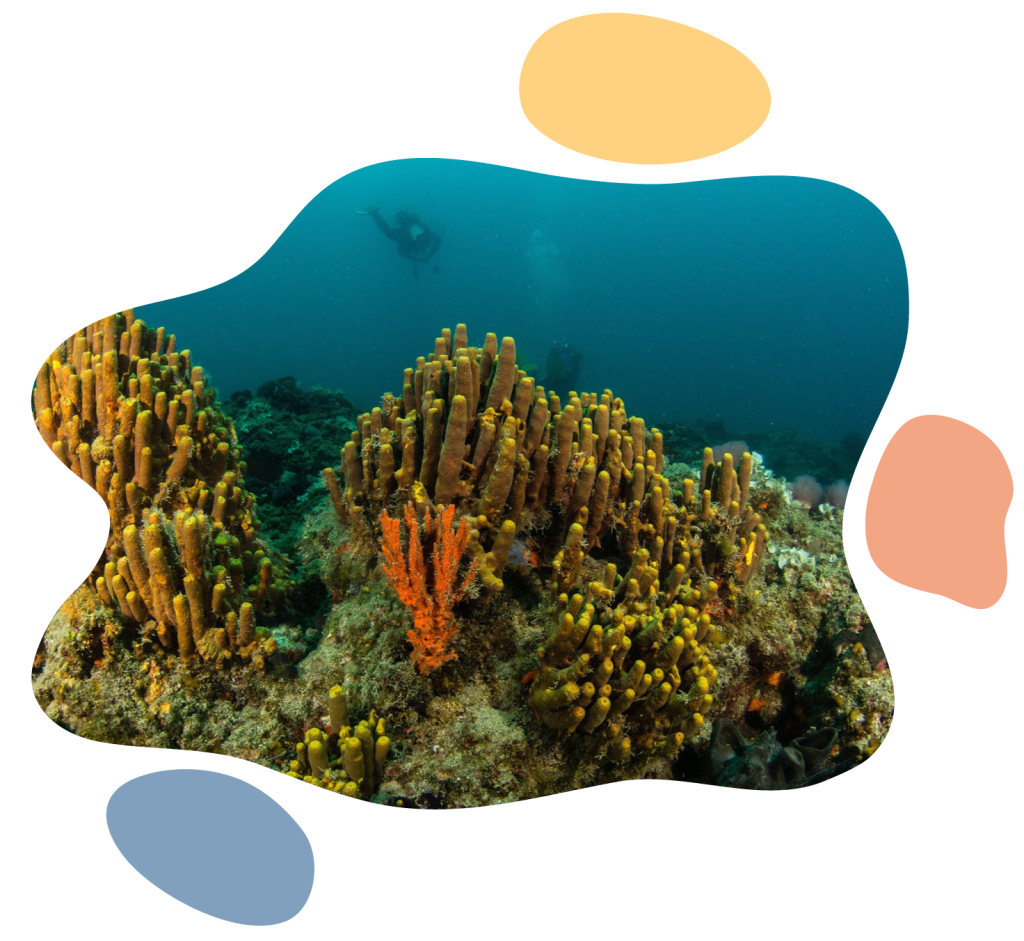
Currently, there are 9,837 valid species (marine + freshwater), however the true diversity of the phylum is estimated to be around 25 000 species, thus many are yet to be discovered and described. Porifera are divided in four main classes, Demospongiae, Calcarea, Homoscleromorpha and Hexactinellida, with the majority (ca. 80 %) of all known species belonging to the class Demospongiae which, in addition, is the only of the four classes to include freshwater representatives (order Spongillida, ca. 200 species). Calcarea (ca. 800 species) are generally small, inconspicuous species, whose main distinguishing characteristic is the possession of a calcareous-based skeleton in opposition to the silicate-based predominant in all other three classes. Long believed to be part of Demospongiae, Homoscleromorpha is the smallest of all four sponge classes (ca. 130 species), its representatives being mostly found in shallow waters, being particularly prevalent in cave environments. Finally, Hexactinellida (ca. 700 species) are almost exclusively restricted to deep-sea habitats or cave environments with deep-sea affinities.
References:
Manconi, R., & Pronzato, R. (2008). Global diversity of sponges (Porifera: Spongillina) in freshwater. Hydrobiologia, 595(1), 27-33. https://doi.org/10.1007/s10750-007-9000-x
Van Soest, R. W., Boury-Esnault, N., Vacelet, J., Dohrmann, M., Erpenbeck, D., De Voogd, N. J., … & Hooper, J. N. (2012). Global diversity of sponges (Porifera). PLoS one, 7(4), e35105. https://doi.org/10.1371/journal.pone.0035105
Under development.
Under development.
Under development.
Under development.
Despite their ecological importance, marine sponges have historically received relatively little conservation attention compared with other marine organisms. Limited knowledge of their taxonomy, distribution, population trends and responses to environmental change has long constrained the assessment of their conservation status and the development of effective conservation measures.
Today, sponge populations are increasingly threatened by climate change, marine heatwaves, habitat degradation, bottom-contact fishing, pollution, invasive species and emerging diseases. As many sponge species are slow-growing and long-lived, their recovery from disturbance may require decades.
SponBIODIV is helping to address these knowledge gaps by providing the scientific evidence needed to support sponge conservation. Through Work Package 5 – Management tools for sustainable conservation of sponge ecosystems, the project has contributed to major international conservation initiatives, including the establishment of the IUCN Species Survival Commission Sponge Specialist Group, the completion of the first Mediterranean IUCN Red List assessments for sponge species, and the strengthening of legal protection for Mediterranean sponge species under the Barcelona Convention (SPA/BD Protocol).
Together with advances in biodiversity monitoring, habitat mapping and conservation assessment, these achievements provide a stronger scientific basis for identifying threatened species, prioritising conservation actions and supporting evidence-based management of marine ecosystems.
References
Bell JJ, McGrath E, Biggerstaff A, Bates T, Cárdenas CA et al. (2015). Global conservation status of sponges. Conservation Biology, 29, 42–53.
Gerovasileiou V, Dailianis T, Sini M, Otero M, Numa C, Katsanevakis S, Voultsiadou E (2018). Assessing the regional conservation status of sponges (Porifera): the case of the Aegean ecoregion. Mediterranean Marine Science, 19, 526–537.
Xavier J, Samaai T, Böhm M, Palmer C (2024). IUCN Species Survival Commission Sponge Specialist Group. Oryx, 58, 690.
Under development.
World Porifera Database (WPD): https://www.marinespecies.org/porifera/
World Register of Marine Species (WoRMS): https://www.marinespecies.org/
Tree of Life (ToL): http://www.tolweb.org/
Sponge Barcoding Project: https://www.spongebarcoding.org/
Spicules: A Database of sponge spicules: https://www.spicules.org/
The Sponge Guide: a picture guide to Caribbean sponges: https://spongeguide.uncw.edu/
Sponge of North East Atlantic 2.0: https://sponges-ne-atlantic.linnaeus.naturalis.nl
Sponges of Britain and Ireland: https://www.habitas.org.uk/marinelife/sponge_guide/