In recent decades, the use of environmental DNA (i.e., genetic material that organisms release into their surroundings; eDNA) has become increasingly popular for monitoring species. Traditionally, this technique has relied on artificial filters. However, about six years ago, researchers began exploring the idea of using sponges as natural filters to collect eDNA since sponges are filter-feeding animals, they can retain in their tissues the eDNA of other organisms living around them. This technique has been validated across several sponge species, revealing that they differ in their potential to act as effective natural samplers of eDNA.
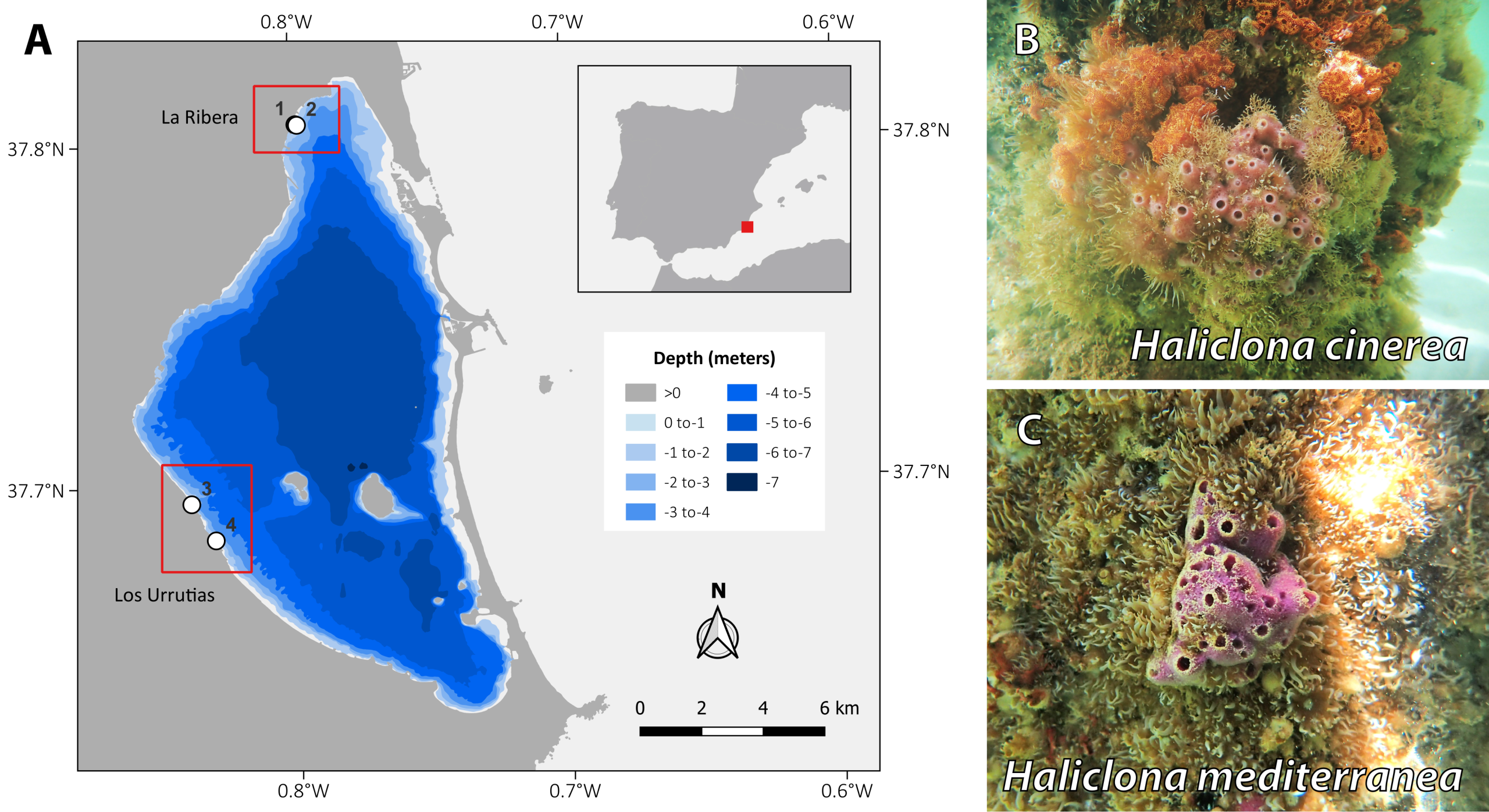
Therefore, researchers from the National Museum of Natural Sciences (MNCN-CSIC), within the SponBIODIV project, explored the potential of the genus Haliclona, also known as the purple tube sponge, as a natural sampler of eDNA in the coastal lagoon of the Mar Menor. To do this, they collected specimens of the genus Haliclona from both the northern and southern areas of the lagoon, during spring and summer. Then, they applied the metabarcoding technique, which uses genetic “barcodes” to identify multiple species from a single environmental sample by amplifying and sequencing specific regions of DNA. The DNA fragment they amplified corresponds to a fragment of the cytochrome oxidase subunit I (COI) gene, known as the “universal barcode,” which enables the identification of most animal species. After bioinformatic analysis of the obtained data, they were able to identify 76 taxa belonging to nine different phyla, with annelids, poriferans, mollusks and cnidarians being the richest groups. But one of the most important findings was that they detected species of conservation concern. They detected emblematic species of threatened status, such as pipefishes (genus Syngnathus) and the piddock clam, Pholas dactylus, and others known to become invasive, such as the ascidians Styela canopus and Botrylloides niger, the barnacle Amphibalanus amphitrite, and the polychaetes Branchiomma bairdi and Branchiomma boholense. These results showed the great potential of the genus Haliclona as natural eDNA samplers, which allowed to characterize both spatial and temporal diversity at the Mar Menor coastal lagoon, further emphasizing the importance of this low-cost approach to monitor biological communities in shallow coastal ecosystems.
Reference:
Corral‐Lou, A., Ramón‐Laca, A., Alcaraz, L., Cassidy, R., Taboada, S., Mariani, S., … & Riesgo, A. (2025). Spatial and seasonal biodiversity variation in a large Mediterranean lagoon using environmental DNA metabarcoding through sponge tissue collection. Environmental DNA, 7(3), e70129. https://doi.org/10.1002/edn3.70129