When we look at the Tree of Life, sponges stand out as some of the most challenging animals to identify and classify. This is because sponges (phylum Porifera), widespread throughout the world, are extremely plastic organisms, with few stable morphological traits, many of which can vary depending on environmental conditions. As a result, several major sponge groups remain poorly understood or even unnamed, a situation that is uncommon among other groups of animals. Discovery of new species of marine invertebrates is daily, that of genera or families less common, while the discovery of a new order is fairly rare (only 12 new orders of animals described in the last 5 years).
A study by Díaz et al. (2025) led by the Museum of Evolution at Uppsala University, Sweden, and published in the Zoological Journal of the Linnean Society discovered a new order of marine sponges that they named ‘Vilesida’. The Vilesida is distributed worldwide, from the Caribbean to the Indo-Pacific, the Mediterranean Sea, and the Atlantic and Indian Oceans. Some vilesids play important ecological roles and can be found in a wide range of habitats, from tropical coral reefs to deep-sea environments. Díaz et al. also describe in this new order a new family (Vilesidae), a new genus (Murus), and two new species from the North Atlantic.
Although the morphology of vilesid sponges is nearly indistinguishable from that of other evolutionary close orders, molecular evidence suggests that these groups diverged during the Mesozoic Era, more than 150 million years ago. Even more remarkably, researchers discovered that vilesids produce a distinctive type of sterol as the main components of their sterol fraction. Instead of using cholesterol in their cells, like humans and many other animals, the vilesids are characterized by rare sterols called 24-isopropylcholesterols (24-ipc sterols), currently only known to be produced in large amounts in these sponges. This finding is particularly significant because these unique sterols are the precursors of fossilized steroids believed to be the oldest known animal biomarker, and found in abundance in early Ediacaran rocks, more than 6oo million years old. Our finding thus further supports the so-called ‘sponge biomarker hypothesis’ which suggests that sponges and therefore animals emerged some 100 million years before what was originally thought (Shawar et al., 2025).
This study is the result of a collaboration between Uppsala University, the University of California, Riverside (USA), Geomark Research Institute (USA), the Spanish Institute of Oceanography (IEO-CSIC), and the National Museum of Natural Sciences in Madrid (MNCN-CSIC, Spain).
These discoveries represent an important step forward in our knowledge of sponge classification and evolution, marine biodiversity and the history of life on Earth. The unusual steroids made by vilesid sponges continue to be of great interest as the basis of new antimicrobial, anticancer and antiviral drugs, since these serve as potent chemical defenses for animals.
This study is supported by the SponBIODIV project, funded by Biodiversa+ (co-funded by the EU, FORMAS and ‘Fundación Biodiversidad’), which is aiming to establish a sponge biodiversity baseline knowledge in the Atlanto-Mediterranean region. The sterol analyses were made in Gordon Love’s Lab at the University of California Riverside, USA, funded through a NASA Exobiology grant. Several of the specimens used in this study were collected on cruises from the LIFE IP INTEMARES project, coordinated by the Biodiversity Foundation of the Spanish Ministry for the Ecological Transition and the Demographic Challenge, with financial support from the European Union’s LIFE program and the CIRCA-LEBA and CIRCAROCK research surveys, carried out under project 18-ESMARES2-CIRCA, which is part of the Marine Strategy Framework program, co-funded by the same Ministry.
Díaz J.A., de la Torriente A., Zumberge A., Taboada S., Serrano A., Rios P., Cristobo J., Gracia C., Ana Riesgo, Love G.D., Massutí E. and Cárdenas P. (2025) Vilesida, a new order of demosponges revealed by molecular phylogeny and abundant 24-isopropylcholesterols (24-ipc sterols). Zoological Journal of the Linnaean Society. https://doi.org/10.1093/zoolinnean/zlaf163
Shawar L., Love G.D., Uveges B.T., Zumberge J.A., Cárdenas P., Giner J.-L. and Summons R.E. (2025) Chemical characterization of C31 sterols from sponges and Neoproterozoic fossil sterane counterparts. Proceedings of the National Academy of Sciences, 122(41), e2503009122. https://www.pnas.org/doi/abs/10.1073/pnas.2503009122
URL: https://academic.oup.com/zoolinnean/article-lookup/doi/10.1093/zoolinnean/zlaf163
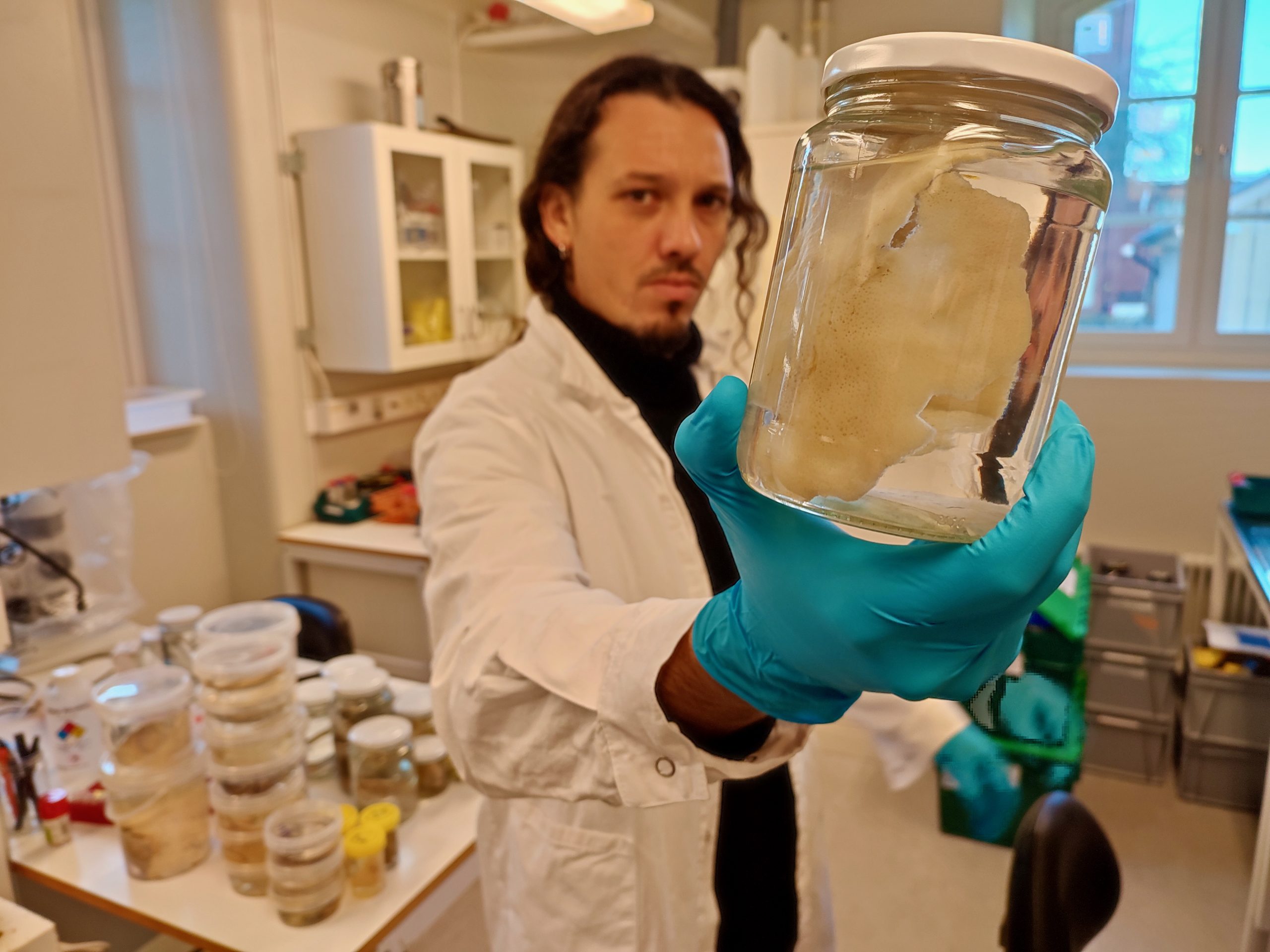
Picture by Paco Cárdenas.